
Short answer: The Charaka Samhita and the Sushruta Samhita are the two foundational texts of Ayurveda. The Charaka Samhita is the classic of internal medicine, and the Sushruta Samhita is the classic of surgery. Both took shape over centuries, from the last centuries BCE into the early centuries CE, and scholars debate their exact dates.
Every field of medicine has its founding books. For Ayurveda, two stand above the rest. One teaches the physician how to reason about disease, food and treatment. The other teaches the surgeon how to cut, suture and rebuild.
The oldest surviving copy of the second book is a palm leaf manuscript held in the Kaiser Library in Kathmandu, completed on 13 April 878 CE [1]. It is about 600 years older than other known textual sources for the two texts. That single fact tells you how carefully these books were copied and cared for over the centuries.
This guide explains what the Charaka Samhita and Sushruta Samhita are, how they differ, what they contain, how old they are and how to read them today. If you are new to the subject, start with our complete guide to what Ayurveda is or our guide to the history of Ayurveda.
What is a Samhita?
A samhita is a collection or compendium. In Ayurveda the word refers to a large systematic text that gathers knowledge on a subject into one organised work. The two texts covered here are the oldest of the great compendia.
Together with the Ashtanga Hridaya, attributed to Vagbhata, they form the Brihat Trayi, the great triad. Many students of Ayurveda study the three together, with the Charaka and Sushruta Samhitas as the foundation.
What is the Charaka Samhita?
The Charaka Samhita is the classic of Kayachikitsa, or internal medicine. It teaches how to understand the causes of disease, how to examine a patient, how to use diet and medicines, and how to act as a physician.
The extant text has eight books, called sthanas, and 120 chapters [2]:
| Section | Chapters | Main subject |
|---|---|---|
| Sutrasthana | 30 | General principles, philosophy and prevention |
| Nidanasthana | 8 | Causes of disease |
| Vimanasthana | 8 | Training of the physician, medical ethics and diet |
| Sharirasthana | 8 | Anatomy and embryology |
| Indriyasthana | 12 | Diagnosis and prognosis |
| Chikitsasthana | 30 | Treatment |
| Kalpasthana | 12 | Preparation of medicines and toxicology |
| Siddhisthana | 12 | Success of treatment and Panchakarma |
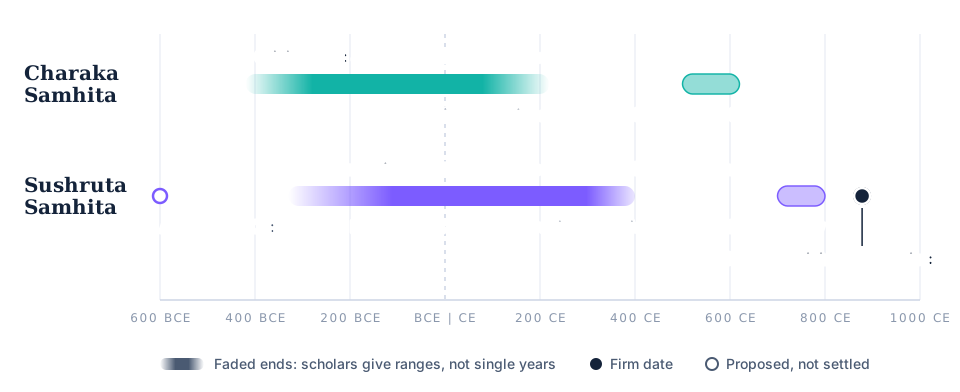
The text builds on an earlier compendium attributed to Agnivesha, which Charaka revised and renamed. Scholars date the original Charaka text between the 4th century BCE and the 2nd century CE, and the revision by Dridhabala to about the 6th century CE. The dates are uncertain [2]. The extant manuscripts descend from Dridhabala's revision.
The Charaka Samhita is known for its systematic approach to the physician's task. It sets out how to examine a patient, describes the doshas and their behaviour, and gives detailed teaching on diet, daily routine and seasonal practice. Our guides to Vata, Pitta and Kapha, Prakriti, Dinacharya and the Ayurvedic diet all draw on ideas the Charaka Samhita discusses.
What is the Sushruta Samhita?
The Sushruta Samhita is the classic of Shalya Tantra, or surgery, though its scope is wider than that.
In its extant form, the text has 186 chapters organised into six sections. It describes about 1,120 illnesses and 700 medicinal plants, with 64 mineral based and 57 animal based preparations. Britannica notes that the text describes procedures such as rhinoplasty, the removal of a dead fetus and lithotomy, the removal of bladder stones, and that it also describes techniques for dissecting and studying the human body [3]. The text goes beyond surgery, addressing toxicology, paediatrics and pharmacology [3]. It places unusual weight on training, and is described as recommending that students practise on gourds and dead animals before treating patients [3], a teaching, that a surgeon must rehearse before operating, that is one reason the text is still admired.
Britannica says the text probably originated in the last centuries BCE [3]. The settled form was reached by about the 3rd to 4th century CE. Some scholars have proposed earlier dates, such as about 600 BCE, but this should not be stated as settled fact [2].
The medical historian Gerrit Meulenbeld argues that the work contains multiple historical layers, and concluded that the text does not prove that its composer was a single person named Sushruta [2]. Traditionally, however, Sushruta is regarded as the physician credited with the text, and later, secondary accounts describe him as born in Kanyakubja and later settled in Varanasi, where the compendium associated with his name took shape [2]. Early manuscripts attribute the teaching itself to Divodasa, a king of Varanasi, and later editions attribute it to Dhanvantari [2]. We present the biographical details as tradition rather than settled history, since Meulenbeld's own conclusion is that no single author can be confirmed. Titles such as "father of surgery" are best written as "often called."
The oldest surviving manuscript is a palm leaf manuscript preserved at the Kaiser Library in Kathmandu, Nepal, completed on 13 April 878 CE [1]. It has 152 folios written in transitional Gupta script [1]. UNESCO has recognised this manuscript in its Memory of the World Register, describing Ayurveda as South Asia's principal medical system with a deep influence on the cultures around it [1].
Charaka Samhita vs Sushruta Samhita: what is the difference?
| Feature | Charaka Samhita | Sushruta Samhita |
|---|---|---|
| Main focus | Internal medicine, Kayachikitsa | Surgery, Shalya Tantra |
| Structure | 8 sthanas, 120 chapters [2] | 186 chapters in six sections [3] |
| Dating | 4th century BCE to 2nd century CE, revised about 6th century CE [2] | Last centuries BCE, settled by about 3rd to 4th century CE [2][3] |
| Known for | Reasoning about disease, diet, routine and physician ethics | Surgical training, instruments and procedures |
| Attributed to | Charaka, building on Agnivesha, revised by Dridhabala | Sushruta, with teaching attributed to Divodasa or Dhanvantari |
| Oldest surviving manuscript | Not covered here | Kathmandu, 878 CE [1] |
The two texts overlap far more than the table suggests. Both discuss the doshas, diet, medicines and the physician's duties. The Sushruta Samhita includes a great deal of internal medicine, and the Charaka Samhita discusses procedures.
How did the texts survive and spread?
The texts survived through copying, commentary and translation. Hand copied manuscripts were made across centuries, learned commentators wrote explanations, and translations carried the ideas into other languages. Arabic translations of the Sushruta Samhita are said to have appeared in 8th century Baghdad [2].
In modern times, translation opened the texts to a global readership. The first complete English translation of the Sushruta Samhita, by Kaviraj Kunjalal Bhishagratna, was published in three volumes between 1907 and 1916 [4]. P. V. Sharma produced another translation, with the commentary of Dalhana, in 1999 [5]. For the Charaka Samhita, a complete English translation with commentary by Ram Karan Sharma and Bhagwan Dash appeared from 1976 onward, in seven volumes [6]. Dominik Wujastyk's book The Roots of Ayurveda offers selected passages in English [7].
How can you read the texts today?
You do not need to be a Sanskrit scholar. Here is a practical route.
- Start with an introduction. Begin with a general guide, such as our complete guide to Ayurveda, and learn the terms first.
- Read a selected anthology. An anthology of passages, such as Wujastyk's The Roots of Ayurveda, lets you read short sections with helpful notes [7].
- Then try a full translation. Complete translations are long and technical. Use them as reference works, reading a chapter at a time on a subject that interests you.
- Compare translations. Translators differ. Where a term matters, look at more than one version, and note whether a translator has used a modern word for a classical idea.
- Read with a teacher if you can. A trained vaidya or a scholar can explain context that a translation cannot. For any health related use, this step matters most.
How should you treat claims made about the texts?
The two texts are richly quoted online, and not every claim is careful. A few checks help: does it name a chapter, since a real quotation names the text and section? Does it give a single exact date, since scholars give ranges for both texts and a single confident year is a warning sign? Does it use "first" or "oldest" loosely, when "often called" or "traditionally regarded as" would be more accurate? Does it separate tradition from history, attributing accounts of divine origin to tradition rather than stating them as historical fact? And does it treat medical statements with care, since a passage that describes a treatment tells you what the text records, not that the treatment is safe or effective today. Research on Ayurveda is growing, and a 2023 bibliometric analysis of 3,903 Ayurveda clinical articles found that fewer than 5% were Grade A evidence [8].
Frequently asked questions
Which is older, the Charaka or Sushruta Samhita?
Both took shape over centuries, from the last centuries BCE into the early centuries CE, and their date ranges overlap. Scholars do not agree on a simple order [2][3].
Who was Charaka?
He is the physician traditionally credited with revising the compendium of Agnivesha. Beyond that, little is known of him from historical records.
Did Sushruta invent plastic surgery?
We avoid that claim. Britannica states that the text describes rhinoplasty, which places nasal reconstruction in the text's scope [3]. It does not state that it was the first.
Where can I see the oldest manuscript?
It is held in the Kaiser Library, Kathmandu [1].
Key takeaways
The Charaka Samhita and the Sushruta Samhita are the two foundational texts of Ayurveda. One is a great work of internal medicine, and the other a great work of surgery. Both took shape over centuries, from the last centuries BCE into the early centuries CE, and neither can be pinned to a single year. The oldest surviving manuscript of the Sushruta Samhita was completed in 878 CE. Good readers of these texts attribute claims, respect date ranges and separate tradition from evidence.
The same instinct that shaped these two texts, observe carefully, record precisely, and let the next practitioner build on it, is what MEDHAS is built to support in a modern clinic. If that is useful to your practice, explore MEDHAS.
Where to go next
Wondering how modern research treats these classical ideas? Read What Is Evidence Based Ayurveda?, the next guide in this series.
References
- UNESCO Memory of the World. Susrutasamhita manuscript, Kaiser Library, Kathmandu, Nepal (nomination). unesco.org.
- Meulenbeld, G. J. A History of Indian Medical Literature. Vol. IA. Groningen: Egbert Forsten, 1999.
- Encyclopaedia Britannica. Sushruta samhita. britannica.com.
- Bhishagratna, Kaviraj Kunja Lal (ed. and trans.). An English Translation of the Sushruta Samhita, Based on Original Sanskrit Text. 3 vols. Calcutta, 1907 to 1916.
- Sharma, P. V. (trans.). Susruta-Samhita: With English Translation of Text and Dalhana's Commentary Along with Critical Notes. 3 vols. Chaukhambha Visvabharati, Varanasi, 1999.
- Sharma, Ram Karan, and Bhagwan Dash (trans.). Agnivesa's Caraka Samhita: Text with English Translation and Critical Exposition Based on Cakrapani Datta's Ayurveda Dipika. 7 vols. Chowkhamba Sanskrit Series Office, Varanasi, 1976 onward.
- Wujastyk, Dominik (trans.). The Roots of Ayurveda: Selections from Sanskrit Medical Writings. 3rd revised edition. Penguin Classics, London, 2003.
- Thrigulla SR et al. Clinical studies in Ayurveda: a bibliometric analysis of articles indexed in AYUSH research portal. Ayu 2023;43(3):75 to 81.
MEDHAS supports clinical documentation, review and clinic operations. Clinical decisions remain the responsibility of the treating practitioner.