
Short answer: Prakriti is your natural constitution in Ayurveda, described as the relative proportion of the three doshas at the time of conception, and believed to stay the same through life. Vikriti is your current state, which shifts with season, age, diet and stress. A good assessment looks at both, and the tools used to measure Prakriti are still being standardised.
Two people can eat the same meal on the same day. One feels light and energetic. The other feels bloated and heavy. Ayurveda has a way of explaining this difference. Each person, it says, starts life with a natural pattern, and what suits one person may not suit another.
That pattern is called Prakriti. It is one of the most discussed ideas in Ayurveda, and one of the most misunderstood. This guide explains what Prakriti means, how it differs from your present state, Vikriti, how practitioners assess it, and why researchers say the assessment still needs work.
It builds on our guide to Vata, Pitta and Kapha, so read that first if the three doshas are new to you.
What is Prakriti in Ayurveda?
Prakriti is the natural constitution of a person. A 2025 scoping review in the Journal of Ayurveda and Integrative Medicine defines it as an individual's relative proportion of the three doshas at the time of conception, believed to remain unchanged throughout one's life span [1].
The Sanskrit word carries the sense of "original nature." Your Prakriti is not a disease or a fault. It is the baseline against which health and imbalance are judged.
Classical texts, including the Charaka Samhita, discuss Prakriti and the factors said to shape it. Scholars date that text between the 4th century BCE and the 2nd century CE, and the dates are uncertain [2]. Traditional accounts hold that factors present at conception, including the parents' state and the season, influence the constitution.
How many types of Prakriti are there?
The classical texts and the modern research literature describe this a little differently, and it is worth keeping the two apart.
The Charaka Samhita itself describes seven types: three single dosha types, three dual dosha types, and one type in which all three doshas are in equilibrium. A 2025 scoping review of modern assessment tools, by contrast, works with a finer ten type scheme: three single dosha types, six dual dosha types (since a dual type can lean more toward either dosha, for example Vata Pitta versus Pitta Vata) and one balanced type [1]. Neither count is wrong. They come from different sources, a classical text and a modern research review, and a careful reader should say which one they are using.
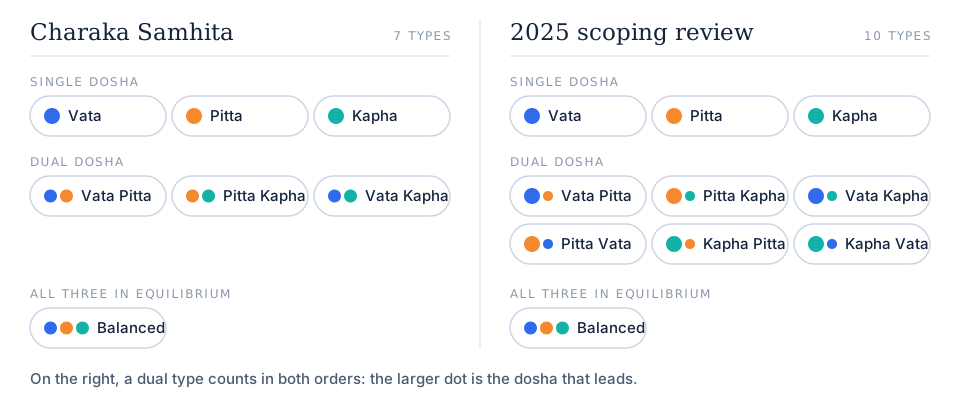
Note that every person still carries all three doshas, in whichever scheme you use. "Vata Prakriti" means that Vata is most prominent, not that the other two are absent.
What is Vikriti?
Vikriti means the current state, or the state of imbalance. If Prakriti is where you started, Vikriti is where you are now.
A useful way to picture it is a house with a thermostat set at a particular temperature. Prakriti is the setting. Vikriti is the temperature at this moment, which may be higher or lower depending on the weather outside, what you have been cooking and how many people are in the room.
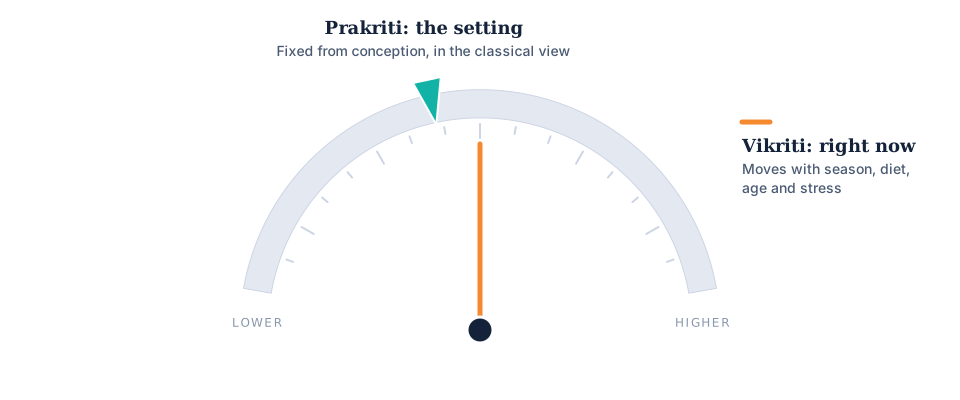
Vikriti can shift within days. A run of late nights, a change of season or a period of stress may all move it. Ayurvedic treatment is usually aimed at Vikriti, with Prakriti used as a guide to which advice is likely to suit you.
Prakriti vs Vikriti: what is the difference?
| Feature | Prakriti | Vikriti |
|---|---|---|
| Meaning | Natural constitution | Current state or imbalance |
| Set when | At conception, according to the classical view | Changes through life |
| Stability | Believed to stay the same | Shifts with season, diet, age and stress |
| Role in care | The baseline that shapes advice | The target of treatment |
| Example | A Pitta dominant constitution | Extra Kapha after weeks of heavy, cold food and inactivity |
How is Prakriti assessed?
In a traditional consultation, a vaidya assesses Prakriti by careful observation and questioning. The physician looks at physical build, skin, hair, digestion, sleep, temperament, stamina and response to weather. The pulse and tongue are examined. A history of how the person has responded to foods and seasons over the years is often the most revealing part.
Modern researchers have developed tools to make assessment more consistent. The 2025 scoping review examined 32 studies and found three categories of tool [1]: questionnaire based tools, of which 16 were identified and which were the most commonly used, algorithm based methods, of which 5 were identified, including approaches that use machine learning, and device based instruments, of which 11 were identified.
The authors reported that among the questionnaires, three had confirmed reliability and validity, though their psychometric robustness was limited. Machine learning methods showed promise but faced challenges in accuracy, replicability and finding the ground truth. Among device based tools, only one was validated and provided access to data for reproducibility [1].
Why is Prakriti hard to measure?
The central difficulty is stated bluntly by the reviewers. There is an absence of a reliable means to establish the ground truth, that is, an individual's actual Prakriti [1]. When you cannot verify the answer, you cannot easily say which tool gets it right.
The review also reports that agreement between trained practitioners is limited, with inter rater reliability ranging from 0.20 to 0.40 [1]. Put simply, two qualified practitioners examining the same person may reach different conclusions more often than one would like.
This is an honest and useful finding. It does not mean Prakriti is meaningless. It means the field, like many young research fields, is still working out how to measure what it describes. It also means a single online quiz should be treated as a rough guide at most.
Does knowing your Prakriti change how you live?
In the classical view, yes, but as a guide and not a rulebook. A person with more Vata is traditionally advised to favour warmth, regularity and rest. A person with more Pitta is advised to favour cooling foods, moderation and avoidance of excess heat. A person with more Kapha is advised to favour lightness, activity and variety. These are traditional patterns, described in more detail in our guide to Vata, Pitta and Kapha, and they are educational, not medical treatment.
How can you make sense of your own Prakriti?
- Learn the three doshas first. Read about Vata, Pitta and Kapha until the vocabulary feels familiar.
- Observe yourself over time. Notice how you respond to seasons, foods, sleep and stress across months, not days. Constitution is a long term pattern, so a single bad week tells you about Vikriti, not Prakriti.
- Separate "usual" from "current." Ask what you have been like for most of your life, and what is different right now. The first points toward Prakriti, the second toward Vikriti.
- Use questionnaires as a starting point only. Given what the research shows about reliability, treat any result as an invitation to learn, not a diagnosis.
- Ask a qualified vaidya. A trained practitioner combines examination, history and judgement in a way no quiz can, and this step matters most if you have a health concern.
What does this mean for clinics?
For practitioners, the message is about records. Because Prakriti assessment depends on careful observation, and because agreement between practitioners is limited, recording how the assessment was made becomes valuable. A record that states which method was used, what findings led to the conclusion and when it was done lets a practitioner, or a colleague, review the reasoning later. That habit also helps future research. Our guide to what an Ayurvedic case sheet should capture sets out what a good record contains, and it is exactly this kind of structured, reviewable record that MEDHAS is built to help a clinic keep.
Frequently asked questions
Can Prakriti change?
In the classical view it does not, and the 2025 review describes it as believed to remain unchanged through life [1]. Your current state, Vikriti, does change.
Is Prakriti the same as personality?
No. It is a broader framework covering body, digestion and temperament. Treating it as a personality label is a simplification.
Is there a genetic test for Prakriti?
Researchers have studied whether constitution relates to genetic differences, but this work is early, and we do not make claims about it here.
How many Prakriti types are there?
The Charaka Samhita describes seven. A 2025 scoping review of modern assessment tools works with ten [1].
Key takeaways
Prakriti is your natural constitution in Ayurveda, described as the proportion of the three doshas at conception. Vikriti is your present state, and it is the part that changes and the part that treatment usually addresses. The classical texts describe seven Prakriti types, and the modern assessment literature commonly works with ten. Assessment by trained practitioners remains difficult, with limited agreement between raters, so treat quizzes as vocabulary and seek an expert for a real assessment.
If a structured, reviewable way of recording Prakriti and Vikriti assessments would help your practice, explore MEDHAS.
Where to go next
Next in the series, read What Are the Charaka Samhita and Sushruta Samhita? to meet the texts that first described these ideas.
References
- Gupta A, Singh V, Chandra S, Garg R. Towards standardization of Prakriti evaluation: a scoping review of modern assessment tools and their psychometric properties in Ayurvedic medicine. Journal of Ayurveda and Integrative Medicine, 2025. PMC12269270.
- Meulenbeld, G. J. A History of Indian Medical Literature. Groningen: Egbert Forsten, 1999 to 2002. Dating of the Charaka Samhita.
- Charaka Samhita, Vimanasthana and Sharirasthana, in Sharma, Ram Karan, and Bhagwan Dash (trans.). Agnivesa's Caraka Samhita: Text with English Translation and Critical Exposition Based on Cakrapani Datta's Ayurveda Dipika. Chowkhamba Sanskrit Series Office, Varanasi, 1976 onward. For the classical discussion of Prakriti and its seven types.
MEDHAS supports clinical documentation, review and clinic operations. Clinical decisions remain the responsibility of the treating practitioner.