
Short answer: Vata, Pitta and Kapha are the three doshas of Ayurveda, described as the functional principles that govern movement, transformation and structure in the body and mind. According to the classical texts, health is a balance among the three, and illness is an imbalance. Everyone carries all three, in a personal proportion.
Ask five people what their dosha is, and you may get five confident answers, several of them from an online quiz. The words Vata, Pitta and Kapha have travelled far from the clinic, into wellness marketing, food packaging and social media.
That popularity has a cost. The ideas behind the words are careful and specific, and they get flattened into labels such as "I am a Pitta, so I am angry." This guide takes the opposite route. It explains the tridosha framework as the classical texts describe it, in plain language, and it says clearly where the framework is a matter of tradition and where research is still catching up.
If you are new to Ayurveda, our complete guide to what Ayurveda is is a good place to begin.
What is a dosha?
The word dosha comes from Sanskrit and is often translated as "humour" or "that which can go out of balance." Johns Hopkins Medicine puts the idea simply: Ayurveda is based on the idea that each person has certain life forces, called doshas [1].
Think of a dosha less as a substance and more as a principle of function. In the classical view, three principles run the body: one that moves things (Vata), one that transforms things (Pitta), and one that holds and builds things (Kapha).
Together they are called the Tridosha, meaning "three doshas." The Charaka Samhita, one of the two foundational texts, discusses them at length. Scholars date the original text between the 4th century BCE and the 2nd century CE, and the dates are uncertain [2]. The framework belongs to a tradition that began more than 3,000 years ago [1].
How are the doshas linked to the five elements?
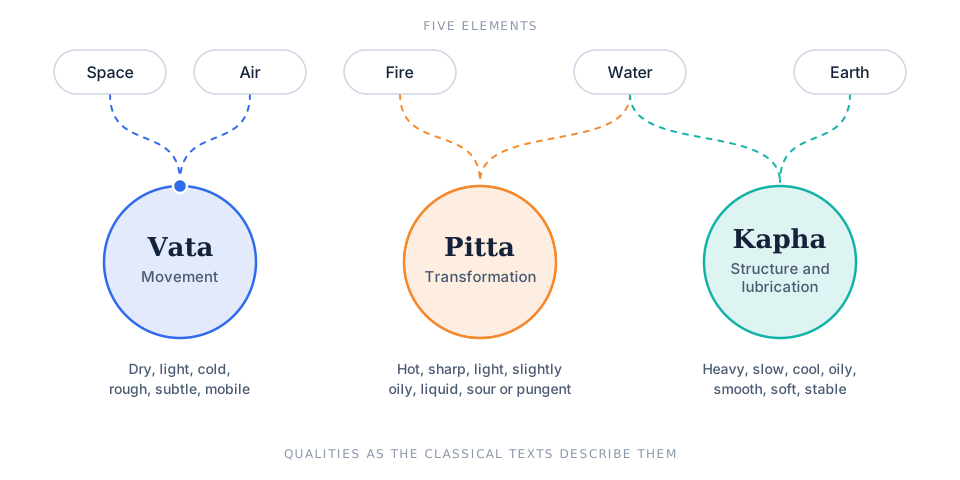
Ayurveda describes the world through five great elements: space, air, fire, water and earth. The doshas are described as combinations of these.
| Dosha | Elements | Core function |
|---|---|---|
| Vata | Space and air | Movement |
| Pitta | Fire and water | Transformation |
| Kapha | Water and earth | Structure and lubrication |
These are symbolic and functional descriptions. Fire does not mean literal flames, and air does not mean the breath alone. The elements are a language for describing qualities, such as heat, lightness or heaviness.
What is Vata?
Vata is the principle of movement. In the classical view it governs anything that moves in the body: the breath, the movement of the limbs, the nervous impulse, the movement of food through the gut and the elimination of waste.
The texts describe Vata as dry, light, cold, rough, subtle and mobile. Traditionally, it is associated with the lower abdomen, the colon, the bones and the ears and skin, though it is described as moving throughout the body. According to the classical descriptions, Vata imbalance can show as dryness, irregular appetite, constipation, restlessness, disturbed sleep and anxiety, and traditional writers link it with cold, dry weather, irregular meals, travel and late nights.
Classical advice for Vata generally favours warmth, regularity and oiliness: warm cooked food, regular meal times, adequate rest and gentle oil massage. This is traditional guidance, not a medical treatment.
What is Pitta?
Pitta is the principle of transformation. In the classical view it governs digestion, metabolism, body heat, vision and the ability to discern and decide.
The texts describe Pitta as hot, sharp, light, slightly oily, liquid and having a sour or pungent character. Traditionally, it is associated with the small intestine and stomach, the liver, the blood, the skin and the eyes. According to the classical descriptions, Pitta imbalance can show as acidity, heat, skin irritation, loose stools and a short temper, and traditional writers link it with hot weather, very spicy, sour or fried food, and intense pressure.
Classical advice for Pitta generally favours coolness and moderation: cooling foods, regular meals that are not skipped, time in nature and relief from excessive competition and heat.
What is Kapha?
Kapha is the principle of structure and lubrication. In the classical view it governs stability, strength, the smooth working of the joints and the fluid balance of the body.
The texts describe Kapha as heavy, slow, cool, oily, smooth, soft and stable. Traditionally, it is associated with the chest, the head, the joints and the stomach's mucous lining. According to the classical descriptions, Kapha imbalance can show as heaviness, sluggishness, excess sleep, congestion and weight gain, and traditional writers link it with cold, damp weather, heavy sweet food and inactivity.
Classical advice for Kapha generally favours lightness and activity: lighter warm food, regular exercise and variety in routine. It is traditional guidance and does not replace a doctor's advice.
How do the doshas change through life, day and season?
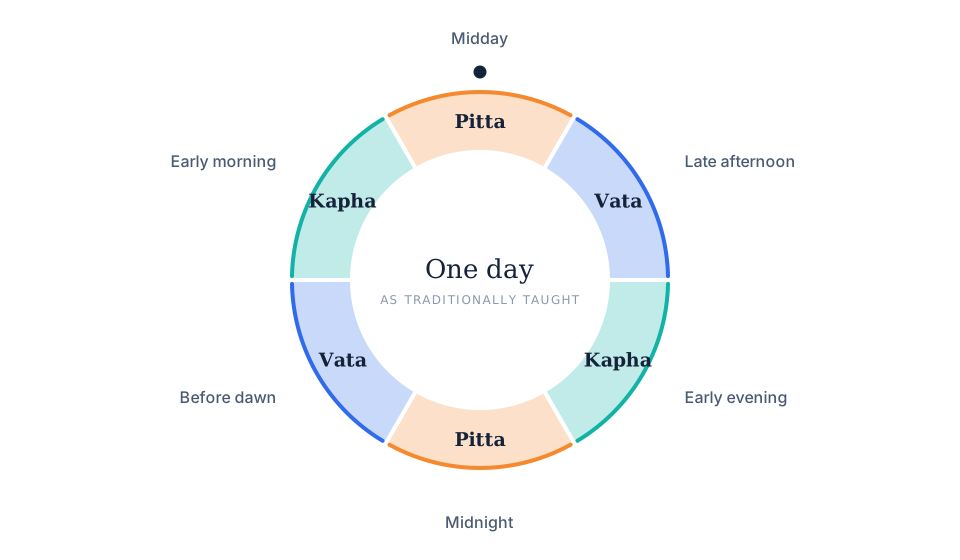
Ayurveda does not treat the doshas as fixed. Classical texts describe childhood as the Kapha stage, adulthood as the Pitta stage and old age as the Vata stage. Through the day, Kapha is said to predominate in the early morning and early evening, Pitta around midday and midnight, and Vata in the late afternoon and before dawn, though different texts and teachers vary in detail. Each season also favours particular doshas, which is why our later guides to Ritucharya, the six seasons, and Dinacharya, the daily routine, matter.
What is the difference between doshas and constitution?
Everyone has all three doshas. The proportions differ from person to person. The balance you are born with is your Prakriti, described as the relative proportion of the three doshas at conception, believed to stay unchanged through life [3]. Ten types are described in the modern assessment literature: three single dosha types, six dual dosha types and one balanced type [3].
What you are like today, which may differ from your Prakriti, is called Vikriti. If your Prakriti is Pitta dominant but you have been eating cold, heavy food and sleeping too much, your Vikriti might show extra Kapha. Read the full explanation in our guide to Prakriti and Vikriti.
Are the doshas scientifically proven?
This is a fair question, and the answer is nuanced.
The doshas are concepts from a traditional medical system. They were developed by observation and clinical practice, not through modern laboratory science. They do not map neatly onto a single organ or a single chemical, so they cannot be measured with a blood test.
Research is beginning to examine related questions, especially around how to assess constitution consistently. A 2025 scoping review in the Journal of Ayurveda and Integrative Medicine looked at 32 studies of Prakriti assessment tools, comprising 16 questionnaire based tools, 5 algorithm based methods and 11 device based instruments. The authors found that questionnaires were the most commonly used tools, that only three had confirmed reliability and validity, and that no reliable means exists to establish an individual's true Prakriti, with agreement between practitioners ranging from 0.20 to 0.40 [3].
So there is honest work to do. Johns Hopkins Medicine says that studies suggest certain Ayurvedic approaches can have positive effects for some conditions when used with standard medical care [1]. NCCIH says that few well designed clinical trials and systematic reviews suggest that Ayurvedic approaches are effective [4]. A 2023 bibliometric analysis of 3,903 Ayurveda clinical articles indexed in the AYUSH Research Portal found that fewer than 5% were Grade A evidence, meaning randomized controlled trials [5]. Our guide to evidence based Ayurveda covers what this means.
How do you use the dosha framework sensibly?
- Treat quizzes as vocabulary, not diagnosis. An online dosha quiz can teach you the terms. It cannot examine you, and given the low agreement among trained practitioners, a short quiz is unlikely to settle anything.
- Notice patterns in yourself. Instead of asking "which dosha am I," ask "what do I notice." Patterns are more useful than labels.
- Work with season and routine. Regular sleep, regular meals and seasonal eating are gentle, low risk steps that fit any of the three doshas.
- See a qualified vaidya for a real assessment. A trained practitioner examines pulse, tongue, digestion, sleep and history, which gives a far fuller picture than a quiz.
- Keep your doctor informed. If you take prescribed medicines, tell every provider about any herb or supplement you use. Johns Hopkins and NCCIH both note that some Ayurvedic products can contain heavy metals, and that herbs can interact with medicines [1][4].
Common myths about the doshas
"I am only one dosha." No. Everyone has all three, and even a single dosha Prakriti has the others in smaller amounts.
"My dosha never changes." Prakriti is described as fixed, but your current state, Vikriti, shifts with season, age, diet and stress.
"Doshas are personality types." They are a health framework. Describing them as fixed personalities is a modern simplification.
"A dosha diet cures disease." Responsible sources do not promise cures. Diet and routine are described as supportive, and they do not replace medical care.
Frequently asked questions
How many doshas are there?
Three: Vata, Pitta and Kapha.
Can I have two doshas at once?
Yes. Six dual dosha Prakriti types are described in the modern assessment literature [3].
Is there a test for dosha?
Practitioners assess it by examination and history. Questionnaires and devices exist, but their reliability is still being studied [3].
Do doshas relate to modern anatomy?
Not directly. They are functional concepts from a different tradition.
Key takeaways
Vata, Pitta and Kapha are three principles of movement, transformation and structure that classical Ayurveda uses to describe health. Everyone has all three. Balance is the goal, and individual patterns matter more than labels. The framework is a traditional one, and research on how to assess it is honest about its limits.
Recording which dosha pattern a practitioner observes, and why, is exactly the kind of structured note that MEDHAS is built to help a clinic keep and learn from over time. If that is useful to your practice, explore MEDHAS.
Where to go next
Curious about your own constitution? Read our next guide, What Is Prakriti? Constitution vs Current Imbalance in Ayurveda.
References
- Johns Hopkins Medicine. Ayurveda. Health, Wellness and Prevention. hopkinsmedicine.org.
- Meulenbeld, G. J. A History of Indian Medical Literature. Groningen: Egbert Forsten, 1999 to 2002. Dating of the Charaka Samhita.
- Gupta A, Singh V, Chandra S, Garg R. Towards standardization of Prakriti evaluation: a scoping review of modern assessment tools and their psychometric properties in Ayurvedic medicine. Journal of Ayurveda and Integrative Medicine, 2025.
- National Center for Complementary and Integrative Health (NCCIH). Ayurvedic Medicine: In Depth. nccih.nih.gov.
- Thrigulla SR et al. Clinical studies in Ayurveda: a bibliometric analysis of articles indexed in AYUSH research portal. Ayu 2023;43(3):75 to 81.
- Charaka Samhita, Sutrasthana, in Sharma, Ram Karan, and Bhagwan Dash (trans.). Agnivesa's Caraka Samhita: Text with English Translation and Critical Exposition Based on Cakrapani Datta's Ayurveda Dipika. Chowkhamba Sanskrit Series Office, Varanasi, 1976 onward. For the qualities, sites, functions and imbalance descriptions of the doshas.
MEDHAS supports clinical documentation, review and clinic operations. Clinical decisions remain the responsibility of the treating practitioner.